 Dropsmith
A DJ set whose tracks do not exist yet.
Dropsmith makes each track with a music model, on your Mac or on your own server, and mixes it on the beat into a set that does not stop. From the same Mac it runs the room: dancers projected on the wall, and DMX lighting that follows the music.
The first version is not out yet: the download opens here when it is. What it brings
For Macs with Apple silicon. 14 days free, then €99 once, with 12 months of updates. No subscription. Listen to excerpts first.


Hear what it makes.
Excerpts of tracks it made, each in the colour of its style. Nothing plays until you press.
-
Prismatic Window
0:53
A groove, a break, and the groove coming back.
-
Dim Mirror V
0:45
Listen for the return after the break.
-
Iron Relay
0:51
A short break, then the return.
These are excerpts of tracks made by Dropsmith with the YuE2 music model, unedited apart from the application's own mastering. YuE2 is the work of its authors, under their licence.
See what it projects.
The dancers, as Dropsmith sends them to a projector, moving on the music it plays.
One Mac runs the room.
Sound, picture and light leave from the same application, on the same clock. Plug in what you have: the set plays with or without the rest.
What goes in
 Dropsmithon your Mac
It plays the set by itself.
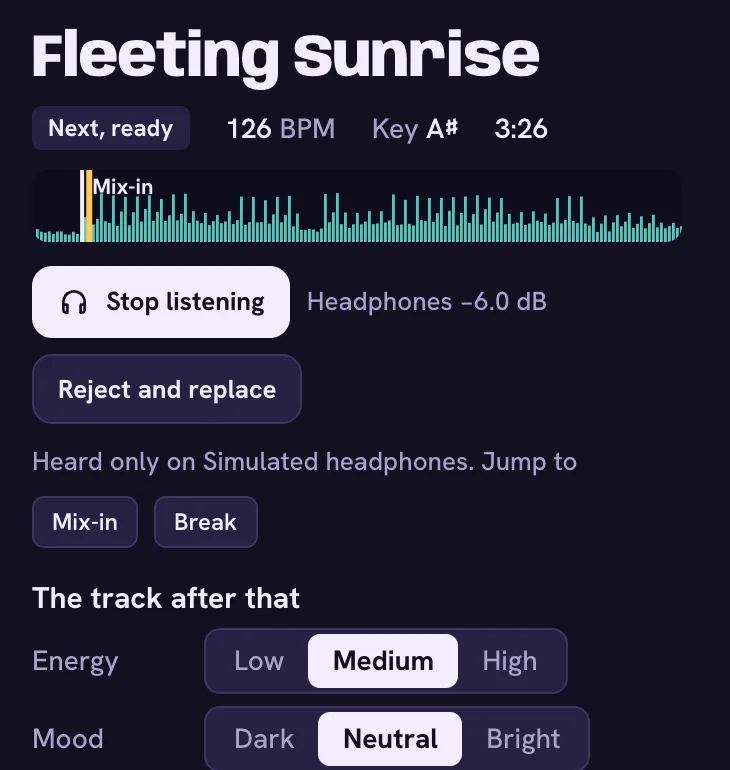
Tracks are mixed on the beat and in compatible keys, the bass swapped on the downbeat, the level held constant. When two tracks do not mix, or when you change style, a beatless interlude bridges them.
The screen shows what no deck shows: the tracks that are still being made, and the mix the machine has already planned. If nothing new is ready in time, the set goes on from your library.
You steer. It mixes.
- Choose the style, the energy, the mood, a voice or none, for the tracks to come. Or leave it on Auto.
- Press Next, and the mix happens in 4 or 8 bars.
- Hear the next track in your headphones first. Reject it if it does not fit: another is made.
- Turn the EQ, the filter, the echo and the reverb on the track that plays.
- Rate tracks with stars. The ratings guide what it picks later.
It makes the music.
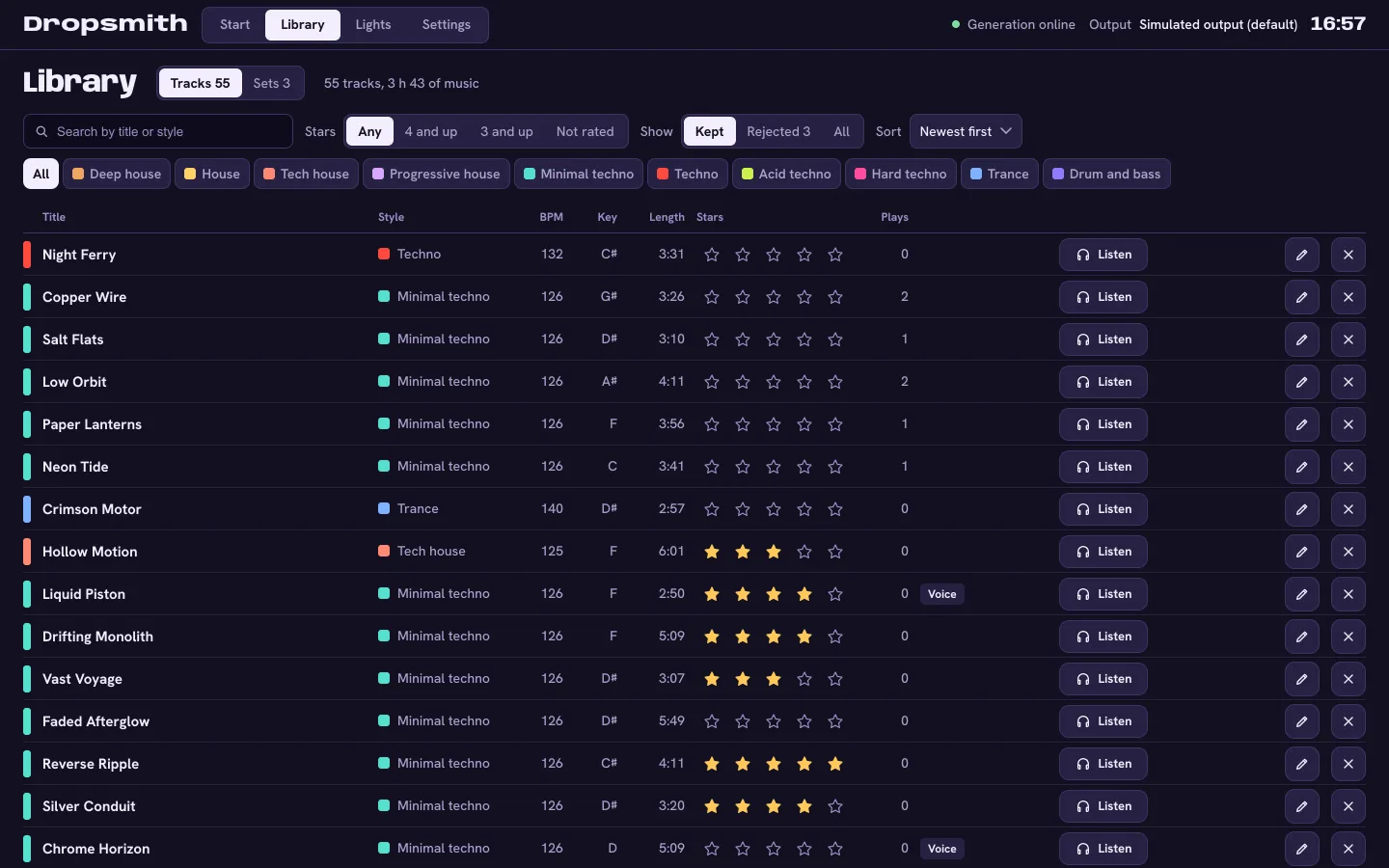
Each track is generated, then analysed for its tempo, its structure, its key and its loudness, brought to the tempo of its style, mastered and screened. What passes is kept in your library, with a title, ready to be mixed. What does not is thrown away.
The model runs on your Mac, or on a generation server of your own. There is no catalogue and no streaming account: nothing plays that was not made for your set.
The model is not part of Dropsmith. See what it needs.
It puts dancers on the wall.
A cast of five 3D performers shares one skeleton and 28 dance clips; four of them are on stage in the pictures here. Their choreography is driven by the music itself: the kicks, the breaks and the drops.
The picture is drawn live by the application, for a second screen or a projector. It is one kind of picture, not a VJ tool: it does not play your clips.
It drives the lights.
The lighting follows the structure of the music, which Dropsmith knows before the track plays: where the break is, where the drop falls.
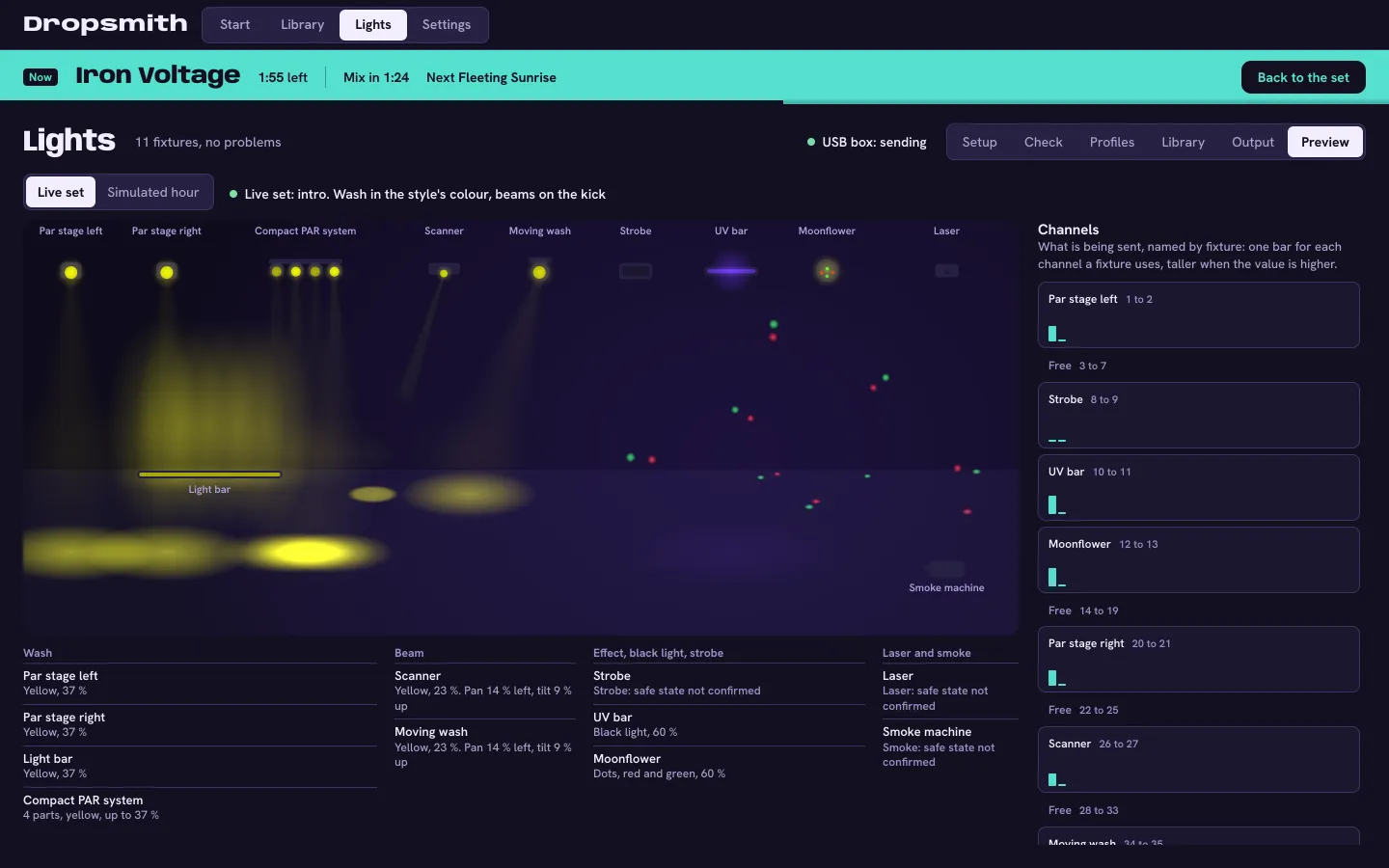
- A search over 2,293 fixtures from two open fixture libraries, and profiles of your own.
- An assistant that plans the DMX addresses and tells you how to set each device.
- A guided check, fixture by fixture, before the night.
- Output over Art-Net, sACN or USB DMX.
Laser, strobe and smoke stay off until you arm them.
Each of the three is armed on its own, by a held press, and only once its safe state is confirmed. A slip of the hand does not fire a laser.
It works with a controller.
Any MIDI controller can be assigned by hand: click a control on the screen, move a knob.
The Akai MIDImix has a preset that uses all its controls, a mask to print in 3D that names each of them, and a guide.
What it needs.
Read this before you download. Making music on a laptop is heavy, and the model is not ours to give.
- A Mac with Apple silicon
macOS 12 or later. It does not run on an Intel Mac or on Windows.
- To make tracks on the Mac
Making a track on the Mac used about 13 GB of memory at its peak, measured on an Apple M5 Max with 128 GB, and a five-minute track took about five minutes there. 32 GB or more recommended; less is untested.
About 11 GB to download for the model, and 15 GB free on the disk. The set plays from the library while a track is being made.
On the Mac alone, a track asked without a voice can still have one: removing voices needs the generation server.
- Or a server of your own
Dropsmith can send the work to a generation server on your network, which makes tracks much faster than the Mac. The server it knows is SPT Models, the publisher's self-hosted model server, sold separately. Dropsmith does not need it: tracks can be made on the Mac.
- The music model, which is not included
Dropsmith drives the YuE2 model and does not ship it. You download it yourself, from the application, under the licence of its authors: CC BY-NC 4.0, with an additional permission for individual creators. A company needs a commercial licence from the model's authors.
The price of Dropsmith buys no right on the model. Read the model's licence before any public or commercial use of the music.
- Two audio tools
ffmpeg and Rubber Band, for the mastering and the tempo work. Dropsmith offers to install them.
- For the room, as you wish
A second screen or a projector for the visuals. An Art-Net or sACN node, or a USB DMX interface, for the lights. Headphones on a second output of the Mac to hear the next track. A MIDI controller.
- The internet, a little
To download the application, the model and the tools, and to check your licence. The set itself plays without it.
What it is not.
Better said here than found out after the download.
It does not play your music.
No library of your own records, no streaming service, no request for a song people know. Every track in the set is generated.
It does not replace decks.
No manual beat-matching, no jog wheels, no scratch, no loops, no cue points of your own. You steer the set; you do not perform the mix.
It is not a VJ tool.
It draws its own dancers. It does not play video clips or map a stage.
It does not speak French.
The interface of the application is in English only.
Who it is for
Someone who wants to hold a room, at home or at a private party, without building a record collection or learning to beat-match. You choose a style, press Next, turn a few knobs, and the room has music, pictures and light until you say stop.
Where it stands.
By kind of product, as their publishers describe them in November 2026. Products differ inside each kind; this is the usual case.
| What you get | Dropsmith | DJ software with automatic mixing | DJ lighting tools | AI music generators |
|---|---|---|---|---|
| Makes the music | YesOn your Mac or your own server | No | No | YesSingle songs, or an ambient stream |
| Mixes a continuous, beat-matched set | YesWith a beatless interlude when two tracks do not mix | YesWith the tracks you own or stream; some only crossfade | No | No |
| Plays your library and streaming catalogues | No | Yes | NoThey follow the DJ software | No |
| Manual decks: jog wheels, cue points, loops | NoYou steer: style, energy, Next, reject, EQ, filter, effects | Yes | No | No |
| Projected visuals | YesOne kind: 3D dancers on the beat | PartlyVideo mixing in several of them | PartlyIn some | No |
| DMX lighting | YesArt-Net, sACN or USB DMX, with arming for laser, strobe and smoke | PartlyBuilt in for a few, else through a separate program | Yes | No |
| Runs on your machine | Yes | YesStreaming needs the internet | Yes | PartlyMostly online services; a few open models run locally |
| How you pay | €99 once, no subscription | A subscription for most, a one-time licence for some | A subscription or a one-time licence | A subscription for most |
If the room must hear songs it knows, a DJ program with your own library is the right tool. Dropsmith is for the night when the music is made for the room.
€99, once. No subscription.
- 14 days free. The trial starts the first time you open the application, with everything unlocked.
- €99, paid once. Your licence covers every version released in the 12 months after your purchase.
- It keeps working after that. Versions released later need a renewal: €39 for 12 more months, only if you want them.
- One key, 3 Macs. A key can be active on 3 Macs of yours at the same time; deactivating it on one frees its place.
- The music model is not in the price. It is its authors', under their licence.
The first version is not out yet: the download opens here when it is. What it brings
Sold through Lemon Squeezy, our reseller, which takes the payment and computes the taxes of your country. The price shown at checkout, with those taxes, is the one that applies. Terms of sale.
Questions.
Can I play my own tracks, or a streaming service?
No. Dropsmith plays only the tracks it generates. It has no way to load a file from your collection or to connect to a streaming service.
Is the music model included?
No. Dropsmith drives the YuE2 model and does not ship it. The application downloads it at your request, about 11 GB, from where its authors publish it, under their licence. Read the model's licence.
May I play the music in public, or sell it?
That is decided by the model's licence, not by ours. Its weights are under CC BY-NC 4.0, with an additional permission for individual creators; a company needs a commercial licence from the model's authors. Read the licence and, if your use is commercial, ask its authors. We cannot give you a right we do not hold.
How long does a track take to make?
A few minutes on the Mac, much less on a generation server. The set does not wait: it plays from your library, and a beatless interlude bridges the gap if nothing is ready.
Does it work without the internet?
The set does: with the model on the Mac, nothing leaves the room. The application needs the internet to download the model and the audio tools, and to check your licence, when it starts and about once a day. A licence checked recently keeps working for a few days without a connection.
What happens at the end of the trial?
Without a licence, starting a set is blocked. The library, the settings, the lights setup and listening to your tracks stay open. A set that is playing is never cut.
What happens after the 12 months of updates?
Nothing stops. The versions you have keep working for good. If you want a version released after those 12 months, a renewal at €39 covers 12 more. There is no automatic payment.
Which lights and which controllers does it work with?
Lights: any DMX fixture, from the two open libraries it searches (2,293 fixtures) or from a profile you write, through an Art-Net or sACN node or a USB DMX interface. Controllers: any MIDI controller, assigned by hand; the Akai MIDImix has a ready preset.
Can I get my money back?
If you buy as a consumer in the European Union, you have a right of withdrawal of 14 days, as the terms of sale describe it. The trial is there so that you know before you pay.
Does it run on Windows, or on an Intel Mac?
No. Dropsmith is built for Macs with Apple silicon, on macOS 12 or later.
Try it on your own Mac.
The trial is the whole application for 14 days. If the set holds your room, the licence is €99, once.
The first version is not out yet: the download opens here when it is. What it brings